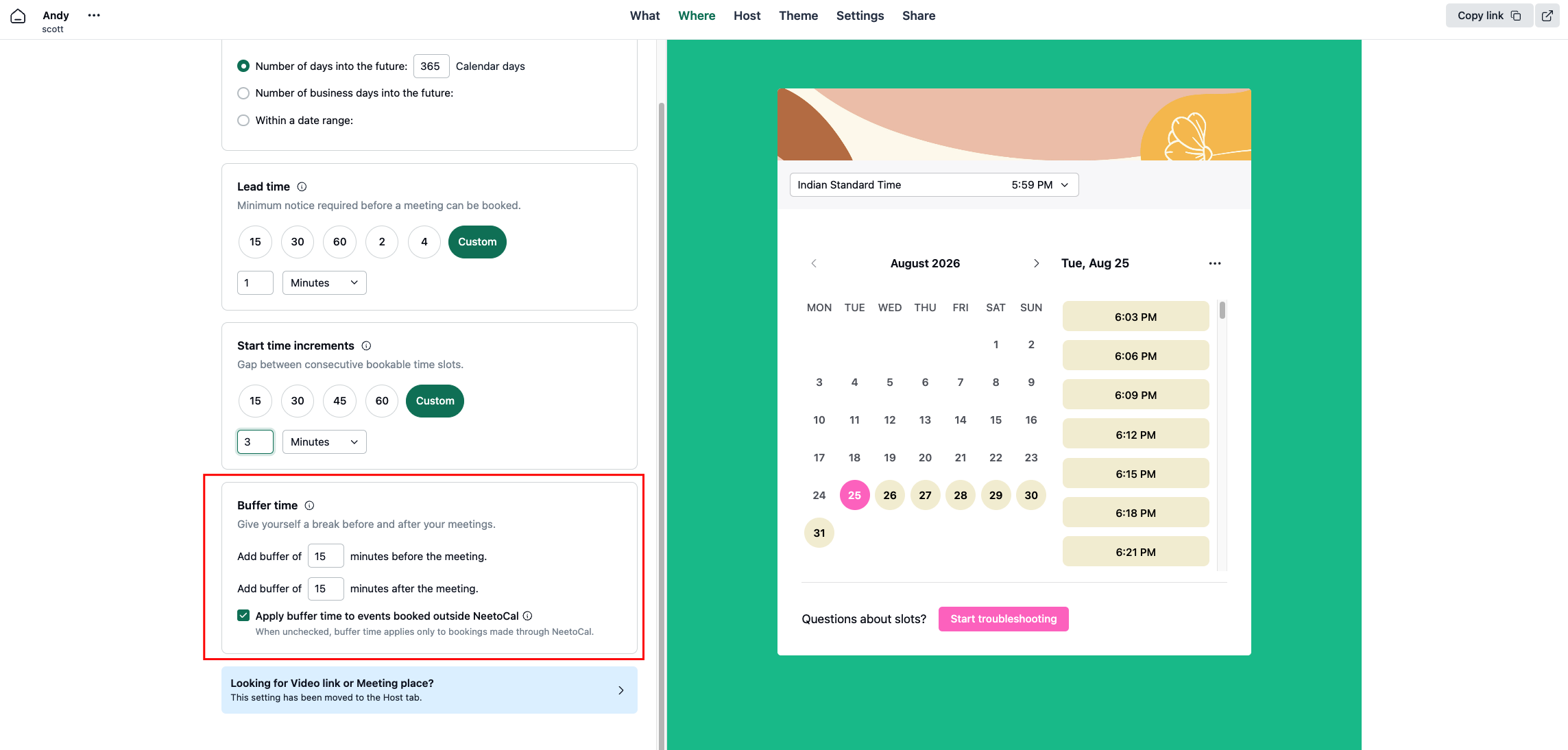

Buffer time is the gap you can add before and after a meeting. This feature helps you schedule your availability, so you can prepare for a meeting and take a breather between meetings. This is also known as "padding time".
Let's look at a few examples.
Buffer time is set to 0 minutes (default)

Client has booked a time slot from 10:00 AM to 11:00 AM. Since there is no buffer time, anyone can book a time slot from 09:00 AM to 10:00 AM and 11:00 AM to 12:00 PM.
Before buffer time is set to 15 minutes
Client has booked a time slot from 10:00 AM to 11:00 AM. At this point, the timeframe looks like the example below.

This booking requires 15 minutes of "before buffer time". Therefore, the time slot from 9:45 AM to 10:00 AM is blocked. Now, the timeframe looks like this.

Now let’s assume that another client books the time slot from 11:00 AM to 12:00 PM. If that happens then the host will not have 15 minutes of “Before buffer time”. Hence, NeetoCal will also block the 11:00 AM to 11:15 AM slot to allow the host 15 minutes of “before buffer time” for the next meeting.
The final result is that a “before buffer time” ends up adding buffer time before the meeting and also after the meeting as shown in the diagram below.

After buffer time is set to 30 minutes
Client has booked a time slot from 10:00 AM to 11:00 AM. At this point, the timeframe looks as shown below.

This booking requires 30 minutes of “after buffer time”. Therefore, the time slot from 11:00 AM to 11:30 AM is blocked. Now, the timeframe looks like this.

Now let’s assume that another client books the time slot from 09:00 AM to 10:00 AM. If that happens, then the host will not have 30 minutes of “after buffer time”. Hence, NeetoCal will also block the 09:30 AM to 10:00 AM slot to allow the host 30 minutes of “after buffer time”.
The final result is that an “after buffer time” ends up adding buffer time before the meeting and also after the meeting, as shown in the diagram above.

Before buffer time is set to 15 minutes and After buffer time is set to 30 minutes.
The client has booked a time slot from 10:00 AM to 11:00 AM. At this point, the timeframe looks as shown below.

This booking requires 15 minutes of “before buffer time” and 30 minutes of “after buffer time”. Therefore, the time slots from 09:45 to 10:00 AM & 11:00 AM to 11:30 AM are blocked. Now, the timeframe looks like this.

Let’s say that another client books a time slot from 09:00 AM to 10:00 AM. If that happens then host will not have 30 minutes of “after buffer time”. Hence, NeetoCal will also block the 09:15 AM to 09:45 AM slot.

If the client books a time slot from 11:30 AM to 12:30 PM, the host will not have 15 minutes of “before buffer time”. Hence, NeetoCal will also block the 11:30 AM to 11:45 AM slot to prevent this conflict.

Buffer time and events from connected calendars
By default, NeetoCal applies the same buffer time to events on your connected calendars.
If you turn this off, calendar events still block their own time, but NeetoCal does not keep buffer time around them. Meetings booked through NeetoCal always get the buffer time.
For example, with a 30-minute buffer after the meeting and a calendar event from 2:00 PM to 3:00 PM:
Setting on: the next slot customers can book starts at 3:30 PM.
Setting off: the next slot starts at 3:00 PM.
Adding buffer time
Go to Scheduling links and open the scheduling link.
Open the Where tab and scroll to Buffer time.
Enter the number of minutes to keep free before the meeting and after the meeting.
Keep Apply buffer time to events booked outside NeetoCal checked if you also want buffer time around calendar events. Otherwise, uncheck it.
-
Click Save.